Jeanette MacDonald’s funeral took place sixty-one years ago today. Last November, Katie Gardner shared a discovery of extraordinary significance—one that verified, yet again, what we had known for decades about that day. This letter, combined with the newsreel footage Katie and Angela previously unearthed, leaves no doubt about what transpired. This is a lengthy article, but these are the facts.
Between 1971 and 1973, I spoke with people who had attended Jeanette’s funeral. What they described was striking: Nelson Eddy was seen and heard crying, collapsing at one point during the service. He asked for private time alone with Jeanette—and he was granted it.
One source had spoken with an attendant who remained nearby to monitor the open casket and ensure no mourner became hysterical or fainted. Though positioned discreetly out of view, the man stayed even when Nelson requested to be alone—for that very reason. He described Nelson’s anguish in vivid terms: gripping the sides of the casket, crying and speaking to Jeanette, and falling to his knees.
If this sounds melodramatic—yes, it was. But that was Nelson Eddy, a deeply compassionate man.
Consider this passage from one of Isabel Eddy’s letters, quoted in Sweethearts, describing a moment in the 1940s when Jeanette was so weakened after a miscarriage that she didn’t even recognize Nelson at her bedside:
“He dropped to his knees and, clasping her hand firmly, began to talk to God. Never have I heard anything like it. It was the most terrible, the most beautiful, the most awful thing—but beautiful beyond any power of mine to describe.”
I first heard about Nelson’s reaction at Jeanette’s casket in the early 1970s. Two decades later, I read Isabel’s original letter—and was struck by how eerily it mirrored what I’d been told about Nelson at Jeanette’s funeral.
Back in the early ’70s, some of this research about the funeral was done by both myself and Diane Goodrich, and we went back to Blossom to confirm as much of it as possible. Remember that Blossom had difficulty originating statements but was better in answering questions. So we asked her to verify what we’d been told. We also confirmed with her that she and Nelson had a private talk after Jeanette’s death.
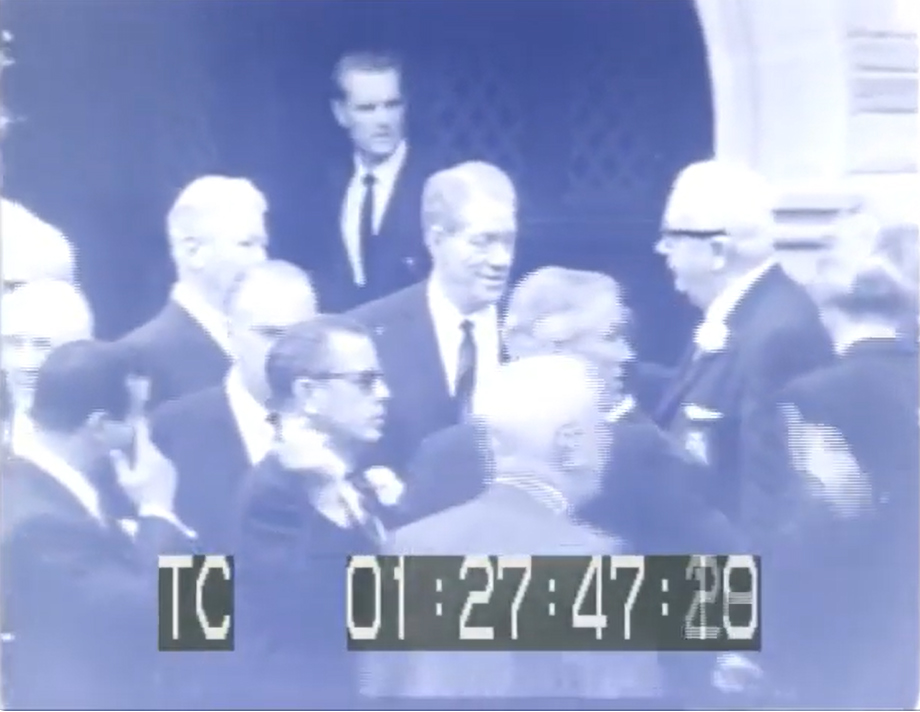
The attendant eventually approached Nelson and told him they needed to close the casket. Nelson composed himself. And here’s the remarkable thing: in 2014, thanks to Katie and Angela locating newsreel funeral footage, we finally saw it on video. Nelson is the last guest to emerge outside into the sunlight, where the honorary pallbearers and public are waiting. Then the door is firmly closed behind him by someone else. Could this be the very attendant I was told about years earlier? I did make phone calls to Forest Lawn to try and learn the man’s name but had no success. Otherwise, I would have interviewed him. But it appears he’s there on film, right behind Nelson.
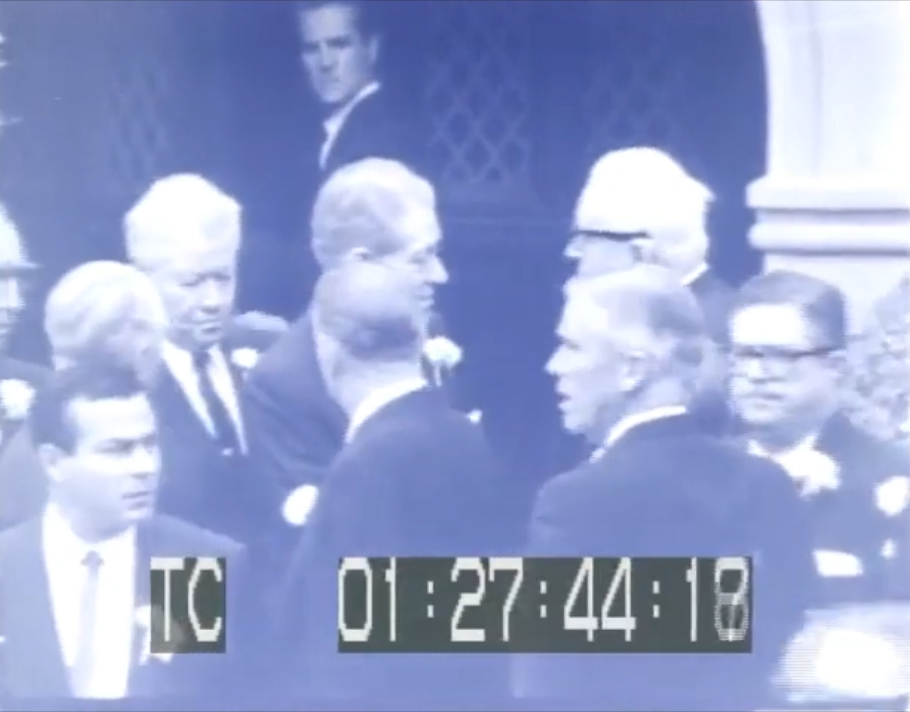
When Nelson exits the chapel, his friends surround him and offer condolences, as though he’s the widower. Lauritz Melchior, a longtime friend of both Nelson and Jeanette, and who was supportive of their relationship, is the first to console Nelson. The casket is carried out and the procession begins.
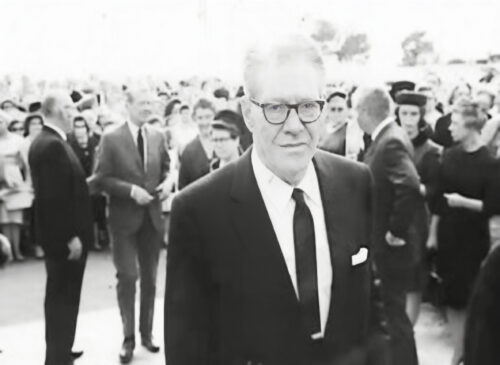
There was another source of slightly different funeral footage that was pulled from the internet years ago. I captured the screenshot at the top of this page from that version and hope I was wise enough at the time to download the footage itself—it may still be on an old hard drive not yet transferred. Perhaps someone else has it. In any case, I highly recommend watching the footage below, still available on YouTube. It’s worth noting that Nelson arrives alone; his wife Ann is shown walking with his nightclub partner Gale Sherwood. He walks quickly, eventually catches up to them, and looks to keep walking.
Fast forward to last November, 2025. Katie had transcribed a letter written by Emily West, Jeanette’s longtime secretary, to Thelma Cohen, who ran the Nelson fan club at the time. The letter, dated 1965, was written in shorthand—a curious choice, unless one considers the sensitive nature of its contents.
Read Katie’s article and the full transcript. You will find yet another verification of what we were told over fifty years ago about Nelson.
But that’s not even the main point.
What’s shocking is that this woman—so staunchly rooted in the Jeanette-Gene camp, who did not particularly like Nelson Eddy and worked behind the scenes to keep him out of Jeanette’s life—wrote it at all. Emily thwarted Nelson at every turn, and he frankly hated her. In public, she denied any romance between Jeanette and Nelson.
I’ve written before about how Emily showed up, uninvited, to my very first radio interview at age twenty. She sat directly across from me, staring me down—daring me to speak the truth. I was a scared kid and said nothing of consequence. Would I have revealed more without her there? Not much—but something. At least an acknowledgment that Jeanette and Nelson had dated, and that the studio discouraged frequent co-stars from marrying (they wouldn’t let Joan Crawford and Clark Gable marry, for example). That much would have been safe to mention.
I later learned that Emily remained on lifetime payroll, continued by Gene Raymond after Jeanette’s death. And Ann Eddy, Nelson’s widow, was the one who had contacted Emily and insisted she attend my interview. Val Davidson, a Nelson fan and friend of Ann Eddy’s, was the one who told me. It turned out Ann was paying Emily as well.
For Emily West to admit the extent of Nelson Eddy’s devastating grief at Jeanette MacDonald’s open casket was, in effect, an admission of everything she had denied—and would continue to deny—for years afterward.
In her letter, she even seems sympathetic to his agony. She describes his emotional state in full view of other mourners. Everyone was crying—how could any decent person not cry watching him—except one person: Ann Eddy, who remained dry-eyed.
Nelson was overcome and had to leave the room, but eventually returned when he could finally be alone with Jeanette.
No wonder Emily wrote the letter in what amounted to a secret code.
Anyone who ever doubted the Jeanette-Nelson relationship should read and re-read Emily’s letter carefully. After describing Nelson’s actions, Emily goes on to reveal what Jeanette’s life was honestly like behind the scenes—the Jeanette we know and understand, who endured so much and tried her best to help others without disappointing or shocking her fans. This admission contradicts the sanitized, lovey-dovey image of Jeanette’s marriage to Gene Raymond that the fan clubs promoted, as well as the carefully curated version of her life presented to the public.
If that letter had ever surfaced publicly through the Jeanette fan club, one has to wonder how it would have been spun. Or how Gene Raymond might have explained it to the world.
Thank you to Katie and Angela for ensuring this letter was finally transcribed and shared. Twenty-first-century research tools have proved invaluable in substantiating work done the old-fashioned way half a century ago—endless hours in libraries, straining eyes over microfilm, turning the fragile pages of yellowed newspapers.
The truth, it seems, has a way of surfacing.
Read Katie’s article and Emily West’s handwritten letter at this link.